Sunday, August 16, 2015

Positively 4th Street

Bob hates so-called friend.
Negatively 4th Street is
Where the guy must live.

"Positively 4th Street", a single from 1965 that appeared on Bob Dylan's greatest hits album in 1967, is the first song of his that I heard where I thought of him as a contemporary artist, even to me in the 1980s, rather than a crusty old folksinger from my parent's generation. I remember hearing it now and again since childhood, but it was only when I was in high school when I finally listened to the words and thought, "Wow, how bitchy, how mean, how cool!" This song, which is of a piece musically and lyrically with "Like a Rolling Stone," is a pissed-off kiss off to someone or someones who landed on Dylan's shitlist. He devotes a few sour verses to this person or people, then gets out.

Namely:
1. You're not really my friend. This is not true because you took pleasure in my earlier distress.
2. You don't really want to help me. You just like me because I'm a winner right now.
3. You say I let you down? Nonsense. If you have a problem, bring it.
4. You don't have any faith to lose so stop saying you have done so.
5. You talk behind my back because we used to socialize together.
6. Why would I seek you out when you don't know anything to begin with?
7. You act cool on the street and ask me small-talk questions. Liar, you don't mean it.
8. You don't like me. You'd like it if I were paralyzed. Don't be afraid to tell me the truth.
9. I don't like the losers you hang out with. I wish I were a thief so I could rob them.
10. You don't like your station in life? Too bad. Not my problem.
11. I wish we could switch places just once.
12. If we were able to switch places, you would realize just how much it sucks to run in to you.


Poor Lazarus

The deputy's task:
Find Lazarus, bring him back.
How? Dead or alive.

Bob Dylan has only one commercial release of "Poor Lazarus" though there are two recordings that I know of. The 1967 release is a fragment on the Basement Tapes sessions that Sony released in their entirety in 2014. It's about a minute long and goes like this:

Oh where the high sheriff told his deputy
Go out and bring me Lazarus
Oh where the high sheriff told his deputy
Go out and find me Lazarus
Dead or alive.

The song "Po' Lazarus" was one recorded by Alan Lomax and Shirley Collins and sung by James Carter while he was a prisoner in the "Parchman Farm," part of the Mississippi State Penitentiary. It's a work song and an "African bad-man ballad," according to the ever trusty stable of Wikipedia contributors. It's also a song to keep time while four men chop down trees, something that the music scholars call a "work song." Here are the lyrics, as performed by "James Carter & The Prisoners," the group being so called because Lomax and Collins didn't know the names of the other prisoners who were singing. (You can hear the song in the soundtrack of the film "O Brother, Where Are Thou?")


Poor Boy Blues

Poor boy cries a lot.
Everyone and thing he sees
Produces fresh tears.

The song "Poor Boy Blues" was released in demo form only on the ninth volume of the Bootleg Series, which collects all the demonstration songs that Bob Dylan wrote for the Witmark publishing company as possible tunes to sell to other artists to perform. It contains nine tiny songs over nine verses, all with the same refrain: "Cain't ya hear me cryin'? Hm hm hm."

Bob Dylan and Nine Stories:
1. Where did you sleep last night?
2. What's wrong with you, baby?
3. Let me jump on this train.
4. I'm old enough for you to serve me a drink, bartender.
5. I run at the sound of the police whistle.
6. Don't charge me for this call, long-distance operator.
7. No difference between ashes and diamonds.
8. Court hears about my general condition.
9. Mississippi River she sure do run swiftly.


Political World

Political world:
Crime, death, fear, compromise: yes.
Love, mercy, God: no.

"Political World" is a general list of grievances about the state of the world, a table of contents of woe that opens the 1989 hit album "Oh Mercy." Dylan sings with an air of bitterness, but keeps the deadpan muffler on to keep from sounding too much like he's shocked to see gambling in this establishment. Producer Daniel Lanois keeps the musicians playing at a brisk clip, propelling the song from verse to verse in a way that keeps the listener hanging on, even though there's about as much variation in the tune as a James Brown funk workout. That's fine. It sounds good.

Aspects of a political world:
- Love has no place
- People commit crimes
- Crime has no face
- Icicles
- People get married
- Clouds cover the ground
- Wisdom is incarcerated, and placed safely out of the public's reach
- Mercy walks the plank
- Life is only a reflection of reality
- Death lives in banks
- Courage is obsolete
- Houses haunted
- Children unwanted
- Every day could be your last
- Even though we know nothing is real, everything seems real
- The deck is stacked
- Cities are lonely and frightening
- Nobody knows the meaning of life
- We're under the microscope
- You can go anywhere and do what you want, and there's always enough rope lying around to hang yourself with if you want
- We're trained to take the easy way out
- Peace is unwelcome and we often bully it
- Everything belongs to someone
- People are attention seekers
- Televangelists shout God's name on air without knowing what they're talking about


Po' Boy

Poor boy's working hard,
A step ahead of the law.
Things will work out fine.

"Po' Boy," which appears on the 2001 album "Love and Theft," is a curious collage built from sources from the Marx Brothers to the novel "Confessions of a Yakuza" by Japanese author Junichi Saga. In between there are references to Blind Willie McTell songs and Shakespeare's "Othello," along with a "knock knock" joke to round it out. It's not a palette that I ever would have thought of, but I'm not Bob Dylan. I can't crack the nut of this song, but I was game to go along with it because its charm sells itself.

Verses:
1. Poor boy shows up. Me: who are you looking for? Him: Your wife. Me: She's in the kitchen, cooking. Don't make me tell you again.
2. I'm at the store, buying something. The guy there wants $3. I offer him $4. "Poor boy -- never say die, things will be all right by and by."
3. I'm working on the mainline, and working hard. "The game is the same -- it's just on a different level. Poor boy -- dressed in black, police at your back."
4. Poor boy's in a happening town beyond the stars, socializing and riding first-class train cars. He's in a precarious spot though, "Tryin' to keep from fallin' between the cars." This says to me that he's not there as a welcome member of the upper class, but as a thief or a fraud or a huckster trying to make his score and get out before being discovered.
5. Othello to Desdemona: I'm cold, I need a blanket, and "by the way, what happened to that poison wine?" Desdemona to Othello: "I gave it to you, you drank it." "Poor boy, layin' 'em straight -- pickin' up the cherries fallin' off the plate."
6. I've been scratched by time and love like they were animals. Just like Blind Willie McTell, I had to go to Florida to avoid prosecution in Georgia. Poor boy, meanwhile, is living in a hotel by the charming name of the Palace of Gloom. "Calls down to room service, says send up a room," like Groucho Marx did. (I also note an oblique reference to Melinda, the one the peasants call the Goddess of Gloom in the song "Just Like Tom Thumb's Blues.")
7. My mother: daughter of a wealthy farmer. My father: traveling salesman. (Dylan's first traveling salesman joke in a song since 1964's "Motorpsycho Nitemare.") I didn't know my father. When Mom died, an uncle who ran a funeral parlor took me in, did lots of nice things for me, and I won't forget him. This is the Yakuza reference, so I've read.
8. Your kiss thrills me. That's all I know. As for Poor boy, he's "pickin' up sticks, build ya a house out of mortar and bricks."
9. The song started with Poor boy knocking at the door, assuming that poor boy and I (or Bob or whoever the other person in the song plays the role of the narrator) aren't the same person. This time, I'm knocking on the door. The guy says "who are you?" I say: "Freddy." He says: "Freddy who?" I say: "Freddy or not, here I come." "Poor boy, 'neath the stars that shine, washin' them dishes, feedin' them swine."


Pledging My Time

Pay attention, girl.
Bob has time for you. It's you
He's not sure about.

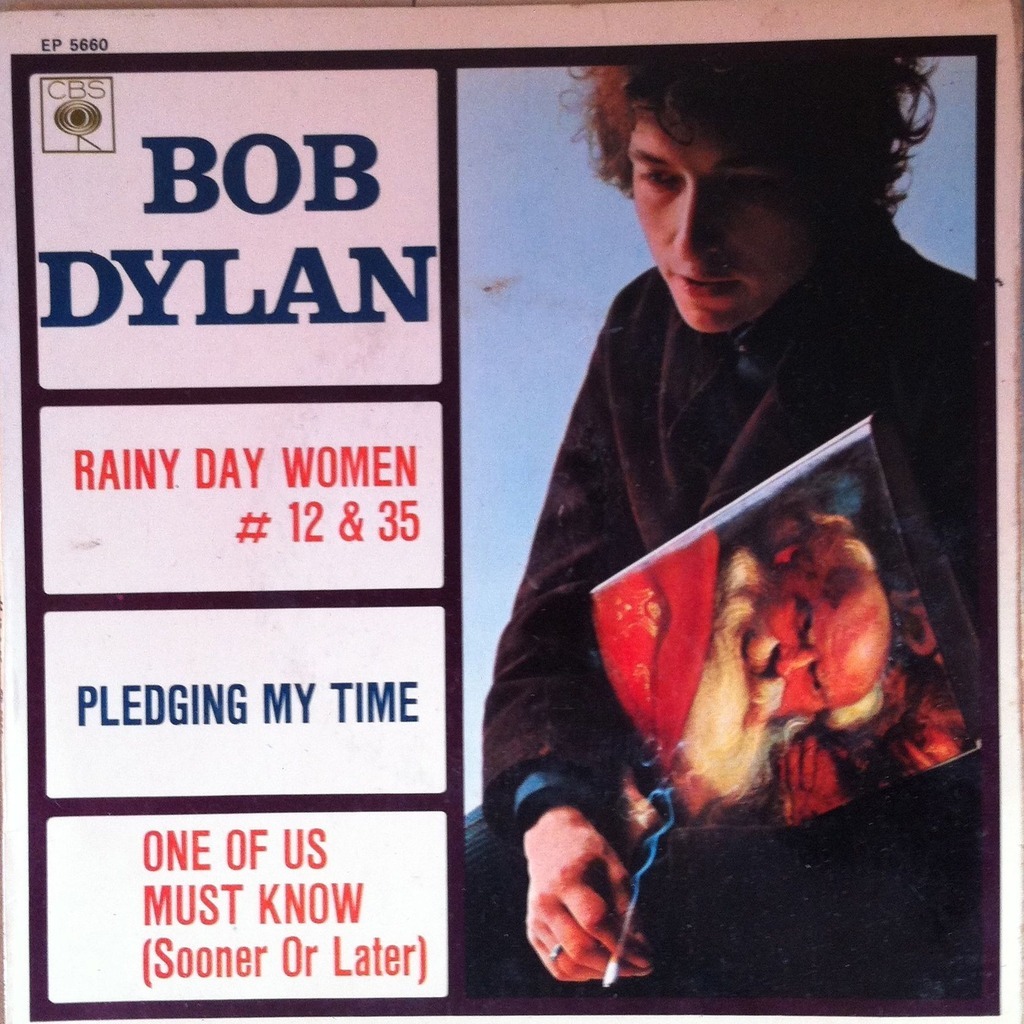
I like the description of "Blonde on Blonde" that Andy Gill gave the album, one that I know about because of my repeated perusing of Wikipedia entries about Bob Dylan: "humid, oppressive atmosphere." He characterizes most of the album this way apart from the opening song "Rainy Day Women #12 & 35." Song two is "Pledging My Time," which was released as well on a single with the preceding song. It's a Chicago blues-style song, I'm told, though I don't know quite what that means other than that it's loud and electric. It's one of the first songs that Dylan recorded in Nashville in 1966, and it features the core of the band that would make the album so beloved, along with keyboardist Al Kooper and guitar player Robbie Robertson who joined him from New York. The song sounds like a take-off on the Robert Johnson blues song "Come on in My Kitchen," and I don't say that just because the Wikipedia entry says so. There are some direct references to the song in the lyrics, at least as far as I can tell. As for the haiku, I took a more stern approach than the song takes, but I felt that it was worth it to take a look at the song from a different angle.

Verses:
1. Got a headache all day and night, though I feel all right. "I'm pledging my time to you, hopin' you'll come through too."
2. Hobo steals girlfriend, then steals me too. Pledging my time, etc.
3. Baby come with me. Though our success is not guaranteed, you'll be the first to know in the event of failure. Which seems possible. Pledging my time etc.
4. Stuffy room. Everybody gone. We're still here, but you'll have to go first before I do. Pledging my time etc.
5. Somebody needs an ambulance, and they got one, though whatever happened was an accident. Pledging my time etc.


Please Mrs. Henry

He's looking for sex,
But he's too drunk and he's broke.
Mrs. Henry knows.

This is one of my favorite songs from the Basement Tapes sessions of 1967, and was one that apparently pleased Dylan and Robbie Robertson enough that they chose it for inclusion on the 1975 album that culled the best tracks from those sessions for one double-LP. There's been plenty of commentary on what's going on in this ribald singalong, but my suspicion is that the singer is looking for some paid company with a lady of the night named Mrs. Henry, but he doesn't have any money so he would like a freebie. Complicating matters is his clearly drunken state, one that the singer is all too aware of. It's undetermined whether he's even able to perform.

A confession to Mrs. Henry:
- I've had two beers, and a broom could sweep me up right about now.
- Will you take me to my room?
- I'm a good boy, but I've had too many eggs and kegs and socializing.
- I'm on my knees, but I don't even have a dime.
- I'm groaning in the hallway and I'm going mad.
- Maybe you should take me to your dad.
- I can: drink life a fish, crawl like a snake, bite like a turkey and slam like a drake.
- I'm a sweet bourbon daddy, but if you crowd me, I'll fill up your shoe (By peeing in it, one might surmise)
- "I'm a thousand years old, And I'm a generous bomb, I'm T-boned and punctured, But I'm known to be calm."
- I'm starting to drain, and my crane might leak (uh huh).

- Perhaps you might look my way and "pump me a few."


Percy's Song

Bob implores the judge
Who sentenced his guilty friend.
The judge says, "Tough shit."

"Percy's Song" is about a falsely accused reprobate who's a friend of the singer. The singer is sure that Percy did not commit the manslaughter that he's been accused of, and implores the judge not to sentence poor Percy to 99 years in prison. The judge is having none of it, and leaves the singer to muse about the cruel rain and the wind, and to sing, throughout each verse, "Turn, turn, turn again... Turn, turn to the rain and the wind."

Summary:
- Bad news: one of your friends is in big trouble
- He's been sentenced to life in Joliet prison
- The charge is manslaughter "in the highest degree."
- You wrote and rehearsed it with the intention of visiting the judge of Wednesday to plead Percy's case.
- You arrive
- You ask the judge to tell him the story of what transpired.
- Percy was driving when his car crashed, killing the four people in the car with him.
- But he wouldn't do something like that! you say.
- Get out of my office. We had a witness.
- But 99 years? That's too much! you say
- He's not a criminal, you say. It could have happened to anyone, you say.
- Get out of my office, please, the judge says.
- You walk down the courthouse stairs and hear the judge slam the door.
- You play your guitar and muse on cruel fate.

The song was recorded in 1963, but was not released until it appeared on the "Biograph" compilation in 1985.


People Get Ready

Salvation by train.
The ride is free, Jesus pays.
Thank God for the trip.

This 1965 song by Curtis Mayfield appeared on one of his albums with the Impressions. It's a song about freedom, using the Underground Railroad as its anchor, though the song is as much about spiritual salvation, the way that I read it. I used for the haiku the main refrain, "People get ready, the train is coming. Don't need to ticket, you just get on board." And the only thing that you have to say for riding this train to freedom is, "Thank the Lord." It's a gorgeous song. Dylan recorded it with the Band during their Basement Tapes sessions in 1967, and you can find that version on volume 11 of the Bootleg Series. He also recorded it in 1989 for the film "Flashback," though I'm not including soundtrack appearances in this collection.


Peggy Day

Peggy Day and Night
Make Bob feel more than all right.
What two girls can do.

A tale of two Peggies. The song "Peggy Day" came out in 1969 on the album "Nashville Skyline," and it's one of Bob Dylan's most insubstantial songs. That's no marker of quality, however. This sweet tune is a keeper and I never grow tired of listening to it.

The story:

1. Peggy Day stole my heart away. By golly, there's not much more than I can say. I love to spend the night with Peggy Day.
2. Peggy Night makes my heart feel all right (Or is she Peggy Knight?) That girl is out of sight. Best to spend the day with Peggy Night.
3. I loved one of these Peggies, maybe both, before I knew their names. Now I tell everybody everywhere I go that I love Peggy, though they might not be sure to which Peggy I refer. I of course refer to both Peggies.
4. Peggy Day stole my heart away. She turned my skies from gray to blue.

You will note that Peggy Night does not make a second appearance.


Pay in Blood

Bob plans his revenge
Against those who did him wrong,
And there will be blood.

This song from the 2012 album "Tempest" could have been called the Cranky Bastard Blues. "Pay in Blood" is six verses of Bob Dylan nearly losing his temper as he counts the ways that he's going to make somebody sorry for hurting him. Instead of bitterness, he's out for revenge, but not before he lists the wrongs that this unnamed villain has committed against him as well as the ways that he has transcended all of them, though not enough to forgive.

1. I'm grinding away each day through this life of toil and pain. I've been through a lot and survived it all, but "I could stone you to death for the wrongs that you done. Sooner or later you make a mistake, I'll put you in a chain that you never will break."
2. Every new day strips away a few more of your hopes. All that dying just makes me live on more, mainly because "I got dogs could tear you limb from limb."
3. Life dealt me a bad hand, but I'm going to play it anyway. I might obey God's laws, but if I do wrong in my quest for satisfaction, then by all means put me in front of a firing squad.
4. "You got the same eyes that your mother does. If only you could prove who your father was."
5. I've been through hell, but I survived. "What good did it do? You bastard! I'm supposed to respect you? I'll give you justice, I'll fatten your purse. Show me your moral virtue first."
6. "You get your lover in the bed. Come here, I'll break your lousy head." And of course, a Shakespeare twist: "I came to bury, not to praise."

And the end of each verse? "I pay in blood, but not my own."


Paths of Victory

Walking a tough road
Of battles and troubles leads
You to victory.

If you're looking for a roadmap to success, you could probably do with a song like "Paths of Victory." The chorus is like an orientation guide for those of you who might be looking to reorient yourselves once in a while as the paths toward social justice, harmony and victory grow difficult to follow, given the various travails that people suffer while engaged in cumbersome tasks:

"Trails of troubles
Roads of battles
Paths of victory
I shall walk."

Here's what else happens in the various verses:

1. Dusty trail, rough road, but there are better roads nearby. "And boys it ain't far off."
2. Down by the river, if you look high, you'll see the silver lining on the clouds in the sky.
3. Dusk is coming, and there's a track, and that's where the wind is blowing at your back.
4. The road is bumpy as it's made of gravel, but there's another road that's easier to walk on.
5. There's a train that you can ride, and if you look out its windows, you can see better days coming from across the fields.

The song was recorded in 1963 for the album "The Times They Are a-Changin'," though it didn't make the cut. It was released officially in 1991 on the first edition of the Bootleg Series. The song was pased on a gospel song by the Rev. John B. Matthias in 1836. It's also known as "Deliverance Will Come" and "The Way-worn Traveler." 


Sunday, August 9, 2015

Oxford Town

They lynch black people
In Oxford, and they tear gas
Protesting white folks.

Here's a Bob Dylan postcard from hell, which in this case is Mississippi. "Oxford Town," from the 1963 album "The Freewheelin' Bob Dylan," is a clear-headed, unhappy examination of what awaits freedom riders and other civil rights advocates who tried to change the South's view on black people.

In Oxford Town:
- Everybody's head's down
- No sunshine
- Hell no I'm not going
- Guns and clubs, used against black people
- They don't let black people in in Oxford Town
- Try to change things in Oxford Town, you get tear gassed
- Two people were assassinated here for campaigning on behalf of civil rights and equal rights. 


Outlaw Blues

Bob needs some good luck.
He feels like Jesse James, but
Looks like Robert Ford.

This is a hard-rocking song from the 1965 album "Bringing It All Back Home." Considering the big hits on this album, this song and "On the Road Again" tend to be forgotten. It's hard to measure up to songs like "Subterranean Homesick Blues," "She Belongs to Me" and "Mr. Tambourine Man." Still, it deserves a little more attention. This song has some terrific, raucous, noisy playing, and it produced that great line, "Especially when it's nine below zero and three o'clock in the afternoon." That's when it is, as Dylan says, "hard to stumble and land in some funny lagoon." I wasn't quite sure what to do about that lyric, as well as the other verses about wishing he were on some Australian mountain range just for the change, and wearing his dark sunglasses and lucky black tooth, not to mention the brown-skinned woman who he's keeping anonymously in Jackson. I focused on the second verse:

Ain’t gonna hang no picture
Ain’t gonna hang no picture frame
Ain’t gonna hang no picture
Ain’t gonna hang no picture frame
Well, I might look like Robert Ford
But I feel just like a Jesse James

The picture frame, I would guess, refers to the picture that James decided to dust as it hung over his mantle in the living room of his home. It was while he was doing this that Robert Ford shot him in the back of the head, killing him. Ford already was in cahoots with the governor of Minnesota to betray his fellow outlaw, so was immediately pardoned after he and his brother Charley were sentenced to death by hanging for first-degree murder.


Open the Door, Richard

Bob's proverb service:
Remember your memories
And forgive the sick.

"Open the Door, Richard" also known as "Open the Door, Homer," is a variation on the old Vaudeville number, though Dylan's version, recorded in the Basement Tapes sessions of 1967, sounds more of a piece with the homespun homilies of old-timey America. What elevates this song above other material from those recordings in Saugerties that summer is its mysterious admonitions about living a moral life, combined with the apparently nonsensical "Open the door, Richard" chorus. There are a ton of versions of this song, and "Open the Door Richard," apparently became a catchphrase for some time, appearing on TV shows, films, cartoons and so on. I've included a few versions of the song below, along with the completely different lyrics for the Dylan song. His version appeared on the 1975 Basement Tapes album, and a few other takes appeared on the complete Basement Tapes sessions that were released in 2014 as volume 11 of the Bootleg Series. I find this to be one of the most fascinating and mysterious songs that I've ever heard.

Now, there’s a certain thing
That I learned from Jim
That he’d always make sure I’d understand
And that is that there’s a certain way
That a man must swim
If he expects to live off
Of the fat of the land
Open the door, Homer
I’ve heard it said before
Open the door, Homer
I’ve heard it said before
But I ain’t gonna hear it said no more

Now, there’s a certain thing
That I learned from my friend, Mouse
A fella who always blushes
And that is that ev’ryone
Must always flush out his house
If he don’t expect to be
Goin’ ’round housing flushes
Open the door, Homer
I’ve heard it said before
Open the door, Homer
I’ve heard it said before
But I ain’t gonna hear it said no more

“Take care of all your memories”
Said my friend, Mick
“For you cannot relive them
And remember when you’re out there
Tryin’ to heal the sick
That you must always
First forgive them”
Open the door, Homer
I’ve heard it said before
Open the door, Homer
I’ve heard it said before
But I ain’t gonna hear it said no more

The original song, which was a black Vaudeville number, is about a drunk guy who leaves the bar to go home. It's raining, and his roommate Richard won't let him in. This became the basis for a lot of ad libbing, including complaints about racism from the cops and all sorts of other issues, though the basic tone of the song is comic. There are a few versions here.


On the Road Again

Your crazy family
Is unbearable, and you,
How do you stand it?

I've always appreciated this weird little song from "Bringing It All Back Home", which came out in 1965. Dylan describes the miserable state of affairs in a woman's house, most of which are brought on by her eccentric and intolerable family. Here's a brief rundown:

1. Bob wakes up, sees frogs in his socks. Mom's hiding in the refrigerator. Dad's wearing a Napoleon Bonaparte mask.
2. He pets her monkey and gets clawed. He spots someone in the fireplace. She says it's Santa Claus. A milkman appears in a derby hat.
3. He's hungry, asks for food, gets brown rice, seaweed and a dirty hotdog.
4. Granddad's cane is a sword. Grandma's praying to pictures on a board. Bob's sweetheart's uncle picks Bob's pockets.
5. Fistfights in the kitchen, a mailman who gets too involved in the refereeing. Even the butler has a stake in the outcome.

Here is how each verse ends:

1. Then you ask why I don’t live here
Honey, do you have to ask?
2. Then you ask why I don’t live here
Honey, how come you have to ask me that?
3. Then you ask why I don’t live here
Honey, I gotta think you’re really weird
4. Then you ask why I don’t live here
Honey, I can’t believe that you’re for real
5. Then you ask why I don’t live here
Honey, how come you don’t move?


Only a Pawn in Their Game

Black man killed down south,
Whites are caught in a web too.
Someone pulls their strings.

This is a song about the assassination of civil rights leader Medgar Evers. It examines the idea of individual responsibility vs collective evil in the perpetuation of racism in the United States, similar to the idea of individual operators in the Nazi death machine from 1933 to 1945. Are the individual criminals to blame? Or were they following orders? Or were they brought up that way by entrenched powers to act in a way that they can't control because it's in their breeding? Dylan seems to conclude that it's a mixture, though he makes an interesting defense of the poor, white, uneducated man who's manipulated by forces bigger than he is to behave in accordance with their ambitions. It would be interesting to get this song out there in public again more than 50 years after it appeared to see what modern audiences would make of it. You can find it on the 1963 album "The Times They Are a-Changin'."

A bullet from the back of a bush took Medgar Evers’ blood
A finger fired the trigger to his name
A handle hid out in the dark
A hand set the spark
Two eyes took the aim
Behind a man’s brain
But he can’t be blamed
He’s only a pawn in their game

A South politician preaches to the poor white man
“You got more than the blacks, don’t complain.
You’re better than them, you been born with white skin,” they explain.
And the Negro’s name
Is used it is plain
For the politician’s gain
As he rises to fame
And the poor white remains
On the caboose of the train
But it ain’t him to blame
He’s only a pawn in their game

The deputy sheriffs, the soldiers, the governors get paid
And the marshals and cops get the same
But the poor white man’s used in the hands of them all like a tool
He’s taught in his school
From the start by the rule
That the laws are with him
To protect his white skin
To keep up his hate
So he never thinks straight
’Bout the shape that he’s in
But it ain’t him to blame
He’s only a pawn in their game

From the poverty shacks, he looks from the cracks to the tracks
And the hoofbeats pound in his brain
And he’s taught how to walk in a pack
Shoot in the back
With his fist in a clinch
To hang and to lynch
To hide ’neath the hood
To kill with no pain
Like a dog on a chain
He ain’t got no name
But it ain’t him to blame
He’s only a pawn in their game.

Today, Medgar Evers was buried from the bullet he caught
They lowered him down as a king
But when the shadowy sun sets on the one
That fired the gun
He’ll see by his grave
On the stone that remains
Carved next to his name
His epitaph plain:
Only a pawn in their game


Only a Hobo

Bum dies on the street.
He might not mean much to you,
But he's human too.

A social consciousness song from 1963. "Only a Hobo" doesn't specifically say that the guy died, but "His face was all grounded in the cold sidewalk floor" and "Only a hobo, but one more is gone" suggest to me that he did. This song appeared on the ninth volume of the bootleg series as a demo version for the Witmark music company. There's also a later version that he recorded around 1969 or 1970 that appears on volume 10 of the bootleg series, which collects recordings from that time.

As I was out walking on a corner one day
I spied an old hobo, in a doorway he lay
His face was all grounded in the cold sidewalk floor
And I guess he’d been there for the whole night or more

Only a hobo, but one more is gone
Leavin’ nobody to sing his sad song
Leavin’ nobody to carry him home
Only a hobo, but one more is gone

A blanket of newspaper covered his head
As the curb was his pillow, the street was his bed
One look at his face showed the hard road he’d come
And a fistful of coins showed the money he bummed

Only a hobo, but one more is gone
Leavin’ nobody to sing his sad song
Leavin’ nobody to carry him home
Only a hobo, but one more is gone

Does it take much of a man to see his whole life go down
To look up on the world from a hole in the ground
To wait for your future like a horse that’s gone lame
To lie in the gutter and die with no name?

Only a hobo, but one more is gone
Leavin’ nobody to sing his sad song
Leavin’ nobody to carry him home
Only a hobo, but one more is gone