Showing posts with label The Bootleg Series Volumes 1–3 (Rare & Unreleased) 1961–1991. Show all posts

Friday, August 21, 2015

You Changed My Life

I ate with the pigs
Until God gently told me:
Pay now, skip dessert.

If you ever wanted to hear God compared to Errol Flynn, "You Changed My Life" is the song for you. This song from 1981 was part of the sessions for the album "Shot of Love," but was held over for a decade until it appeared on the first volume of the Bootleg Series. It's one of his more ponderous Christian songs, and it probably was a wise decision to leave it off the album, though I would have taken it over "Lenny Bruce" any day. Regardless of its middling nature, it has some good zingers in it.

- He was listening to the voices of death walking proudly and talking of conspiracy and trying to frighten him. 
- He was working for a system that he couldn't trust and didn't understand, suffering ridicule and feeling disgust.
- At that point: "But you changed my life, came along in a time of strife. In hunger and need, you made my heart bleed, you changed my life."
- "Talk about salvation, people suddenly get tired. They got a million things to do, they're all so inspired. You do the work of the devil, you got a million friends. They'll be there when you got something, they'll take it all in the end."
- "Well, the nature of man is to beg and to steal. I do it myself, it's not so unreal. The call of the wild is forever at my door. Wants me to fly like an eagle while being chained to the floor."
- My favorite verse: "I was eating with the pigs off a fancy tray. I was told i was looking good and to have a nice day. It all seemed so proper, it all seemed so elite. Eating that absolute garbage while being so discreet."
- You, meanwhile, were treated as an outcast.
- An enemy possessed my body and made decisions for me. I was held back. I couldn't stand. I felt like a stranger in a strange land. (Robert Heinlein, tip of the hat)
- Attributes of the Lord and Savior: companion, friend, heart fixer, mind regulator, true blue, creator, comforter, cause for joy.


Ye Shall Be Changed

You work too hard and
You need a new beginning.
Go get born again.

This romp through judgment day promises that you shall be changed if you're able to hang on until then. The song was recorded in 1979, but didn't appear commercially until 1991 when it was included on the first volume of the Bootleg Series.

You:
Harbor resentment
Don't feel many thrills
Want contentment, but get emptiness instead
Are through with hatred
Have broken bones, ain't nothing sacred
Work with blood, sweat and muscle, and do your hustle
No more loved ones, including maybe your wife and kids
Drink bitter water, eat the bread of sorrow
Don't live for today, but the false promise of tomorrow.
Walk a rough path.

Consider:
The past doesn't control you, but you don't know the future
A new beginning, without emigrating to Russia or Iran
Surrendering to God 

How does it work? Tell me more:
"Ye shall be changed, ye shall be changed
In a twinkling of an eye, when the last trumpet blows
The dead will arise and burst out of your clothes
And ye shall be changed"


Worried Blues

Don't leave me, baby.
I need to go where it's warm.
I've never been there.

"Worried Blues," which showed up on the first Bootleg Series album in 1991, was recorded in 1962 for "The Freewheelin' Bob Dylan" album, but ultimately didn't make it. It's an old folk song that riffs off the line in "Going Down the Road Feeling Bad" about going somewhere warm, as in, "I'm going where the climate suits my clothes." That's the line that Fred Neill used and Harry Nilsson sang in "Everybody's Talkin'," the theme song to "Midnight Cowboy." 

I got those worried blues
And I got those worried  blues
I got those worried blues
I got those worried blues, Lord
I'm a-going where I never been before.
I'm going where the chilly winds don't blow
I'm going where the climate suits my clothes.

Honey baby don't leave me now
Oh honey baby don't leave me now
Honey baby don't leave me now
I got trouble in my mind.

Listen to that cold whistle blow, Lord
Listen to that cold whistle blow
I'm a-going where I never been before.

So I got those worried blues, Lord
I got those worried blues
I'm going where I never been before.


Who Killed Davey Moore?

Boxer dies in ring.
The boxing business is shocked,
Says, "It's not our fault."

Here's a song that Bob Dylan wrote in 1964 about the death of boxer Davey Moore, who suffered irreversible brain damage after a fight and never recovered. It's one of Dylan's journalism songs. It wasn't released until 1991 when it appeared on the first volume of the Bootleg Series. It's done in the style of "Who Killed Cock Robin?"

Alibis for suspects in the murder of Davey Moore:
Referee: I'm obligated to give the crowd the fight that it wants.
Crowd: We didn't show up for lethal actin. We came to see a bit of sweat, which is legal.
Manager: He should have said something if he were not feeling well.
Gambler: I just bet on the fight. I didn't hit him myself.
Journalist: Boxing isn't the only dangerous sport, you know. And I can't make boxing go away so I'm going to write about it.
The other boxer: I'm paid to box. This isn't murder, it's God's will.


Thursday, August 20, 2015

Walls of Redwing

Life in reform school
Isn't so pleasant if the
School is Red Wing.

The Red Wing, Minnesota juvie hall that Dylan describes here sounds like it would have been a paradise playground for Jean Genet, all full of boys aged 12-17, every one of them treated miserably, like bandits and criminals. But apparently this is fiction. Still, Dylan writes a portrait of a teenage lockdown as if it were designed by the team that brought you ADX Florence.

- Dirty mess hall, march to brick wall. Weary/tired. No sing no talk.
- Iron gates, barbed-wire fence, electric fence.
- Keep your head down.
- Guards with clubs looking for a reason to beat you up. 
- Lonely nights, etc. Rain.
- "Oh, some of us’ll end up in St. Cloud Prison. And some of us’ll wind up to be lawyers and things. And some of us’ll stand up yo meet you on your crossroads, from inside the walls, the walls of Red Wing."


Wallflower

"May I ride you home?"
Wallflower asks wallflower
For a late-night dance.

"Wallflower" didn't make an appearance on a Bob Dylan album until 1991 when it was included in the rare/unreleased recordings in the first volume of the Bootleg Series. The song had been around for a while though, mainly because of its appearance on the 1973 album "Doug Sahm and Band" on which Dylan performed as a sideman. The song, which Dylan copyrighted in 1971, is a standard country and western love song.

1. Wallflower, let's dance. I'm sad and lonely like you. As a matter fact, I'm falling in love with you.
2. What are we both doing here? Let's dance.
3. I took one look at you and, regardless of the smoke in this joint, I knew that you would be the one for me.
4. The ending that most of us hope for in such circumstances: "Wallflower, wallflower, take a chance on me. Please let me ride you home."


Walkin' Down the Line

Time for walking shoes.
Troubled man, troubled woman.
She's sick, he's walkin'.

This is a short folk song about wandering, women and money from 1963. Dylan wrote it and performed it in a demo form for the Witmark publishing company, and it was commercially released in 1991 on the first edition of the Bootleg Series.

1. He's walking, feet flying, mind troubled.
2. Gal: heavy-headed. Not feeling well. Feeling better? Time will tell.
3. Money: comes/goes. Holes/pockets/clothes.
4. Sunrise: I saw it. Didn't sleep all night.
5. Shoes: the walking variety. Can't lose with these shoes, though I got the blues.


Wednesday, August 19, 2015

Tell Me

Before I leave you,
Tell me if you love me
Or if you love him.

This could have been a high school slow dance song or, frankly, any kind of big mainstream hit. The song, recorded in 1983, did not get commercial release until 1991 when it appeared on volume 1 of the Bootleg Series. It's the song of a man who knows that his lover loves him no longer, and he's wondering what's going on in her mind, and more specifically, who the guy is that she must be seeing on the side.

Tell me this:
- Has the fire died or does it still burn?
- What are you thinking about? Just a glance will do.
- Should I try to keep you or let you go?
- Whom are you thinkn of when you look at me?
- Can you feel how I feel about you?
- What are the secrets you're keeping?
- "Is your main friend someone who's an old acquaintance of ours?"
- What's going on behind those eyes?
- What happened to the treasure you keep?
- Have you ever tried taking a chance and doing the opposite of what the experts say?
- What game are you playing?
- Do you have morals? Point of view?
- Does anyone pray or cry for you? Who is he?


Talkin' John Birch Paranoid Blues

Spotting communists
Is hard when there aren't any.
Best to check again.

This is an interesting song that was slated for performance on the Ed Sullivan show, until CBS corporate executives demanded that he not play it to avoid risking a libel lawsuit from the John Birch Society, a group of ridiculous sentinels who were trying to guard America against the infiltration of Communists. Dylan walked off the set rather than consider the demands. Sullivan backed Dylan on this, but the performance didn't happen. CBS also forced Dylan to remove the song from the lineup for his second album "The Freewheelin' Bob Dylan." It made its official appearance -- on Columbia -- in 1991 on the Bootleg Series compilation. 

Well, I was feelin’ sad and feelin’ blue
I didn’t know what in the world I wus gonna do
Them Communists they wus comin’ around
They wus in the air
They wus on the ground
They wouldn’t gimme no peace . . .

So I run down most hurriedly
And joined up with the John Birch Society
I got me a secret membership card
And started off a-walkin’ down the road
Yee-hoo, I’m a real John Bircher now!
Look out you Commies!

Now we all agree with Hitler’s views
Although he killed six million Jews
It don’t matter too much that he was a Fascist
At least you can’t say he was a Communist!
That’s to say like if you got a cold you take a shot of malaria

Well, I wus lookin’ everywhere for them gol-darned Reds
I got up in the mornin’ ’n’ looked under my bed
Looked in the sink, behind the door
Looked in the glove compartment of my car
Couldn’t find ’em . . .

I wus lookin’ high an’ low for them Reds everywhere
I wus lookin’ in the sink an’ underneath the chair
I looked way up my chimney hole
I even looked deep down inside my toilet bowl
They got away . . .

Well, I wus sittin’ home alone an’ started to sweat
Figured they wus in my T.V. set
Peeked behind the picture frame
Got a shock from my feet, hittin’ right up in the brain
Them Reds caused it!
I know they did . . . them hard-core ones

Well, I quit my job so I could work all alone
Then I changed my name to Sherlock Holmes
Followed some clues from my detective bag
And discovered they wus red stripes on the American flag!
That ol’ Betsy Ross . . .

Well, I investigated all the books in the library
Ninety percent of ’em gotta be burned away
I investigated all the people that I knowed
Ninety-eight percent of them gotta go
The other two percent are fellow Birchers . . . just like me

Now Eisenhower, he’s a Russian spy
Lincoln, Jefferson and that Roosevelt guy
To my knowledge there’s just one man
That’s really a true American: George Lincoln Rockwell
I know for a fact he hates Commies cus he picketed the movie Exodus

Well, I fin’ly started thinkin’ straight
When I run outa things to investigate
Couldn’t imagine doin’ anything else
So now I’m sittin’ home investigatin’ myself!
Hope I don’t find out anything . . . hmm, great God!


Talkin' Hava Negeilah Blues

Hava Negeilah:
First you say it slowly, then
You yodel loudly.

This is a silly song from 1963. Dylan refers to a "foreign song" that he learned in Utah and it goes something like this etc...

Ha va
Ha va, na
Hava Na...
Ge, Ha va na gi
Lah, Ha va na gei lah

And it ends in a Jewish yodel: o-de-ley-e-e-oo!


Talkin' Bear Mountain Picnic Massacre Blues

A family picnic
Turns into a big fracas.
We should have stayed home.

Hudson River Father's Day cruise to Bear Mountain goes wrong when someone sells counterfeit tickets and too many people show up. Bob Dylan took this one from a newspaper article and turned it into a talking-blues song. It saw official release in 1991 on the first edition of the Bootleg Series.

I saw it advertised one day
Bear Mountain picnic was comin’ my way
“Come along ’n’ take a trip
We’ll bring you up there on a ship
Bring the wife and kids
Bring the whole family”
Yippee!

Well, I run right down ’n’ bought a ticket
To this Bear Mountain Picnic
But little did I realize
I was in for a picnic surprise
Had nothin’ to do with mountains
I didn’t even come close to a bear

Took the wife ’n’ kids down to the pier
Six thousand people there
Everybody had a ticket for the trip
“Oh well,” I said, “it’s a pretty big ship
Besides, anyway, the more the merrier”

Well, we all got on ’n’ what d’ya think
That big old boat started t’ sink
More people kept a-pilin’ on
That old ship was a-slowly goin’ down
Funny way t’ start a picnic

Well, I soon lost track of m’ kids ’n’ wife
So many people there I never saw in m’ life
That old ship sinkin’ down in the water
Six thousand people tryin’ t’ kill each other
Dogs a-barkin’, cats a-meowin’
Women screamin’, fists a-flyin’, babies cryin’
Cops a-comin’, me a-runnin’
Maybe we just better call off the picnic

I got shoved down ’n’ pushed around
All I could hear there was a screamin’ sound
Don’t remember one thing more
Just remember wakin’ up on a little shore
Head busted, stomach cracked
Feet splintered, I was bald, naked . . .
Quite lucky to be alive though

Feelin’ like I climbed outa m’ casket
I grabbed back hold of m’ picnic basket
Took the wife ’n’ kids ’n’ started home
Wishin’ I’d never got up that morn

Now, I don’t care just what you do
If you wanta have a picnic, that’s up t’ you
But don’t tell me about it, I don’t wanta hear it
’Cause, see, I just lost all m’ picnic spirit
Stay in m’ kitchen, have m’ own picnic . . .
In the bathroom

Now, it don’t seem to me quite so funny
What some people are gonna do f’r money
There’s a bran’ new gimmick every day
Just t’ take somebody’s money away
I think we oughta take some o’ these people
And put ’em on a boat, send ’em up to Bear Mountain . . .
For a picnic


Monday, August 17, 2015

Someone's Got a Hold of My Heart

Woman snares a man
Who's all wrapped up in intrigue.
He wants to get out.

This outtake from the sessions for the 1983 album "Infidels" appeared in a mostly rewritten form two years later on the 1985 album "Empire Burlesque," now known as "Tight Connection to My Heart (Has Anybody Seen My Love?)" The title makes the point of the song pretty clear, but here's a bit of a deconstruction nonetheless:

1. It's hard to seize life when you are so far away.
2. There's too much talk out there, so you find it harder to recognize traps. 
3. Moon's coming up, storm's coming on, you stay inside and stay warm.
4. Been to a city full of espionage and covered by red skies. Streets eat themselves.
5. Madame Butterfly told me, "Be easy, baby, ain't nothin' worth stealin' here."
6. I'm in love with you, but you should realize that I'm not just one more guy for hire.
7. There's a "hot-blooded singer" crooning "Memphis in June" while a guy in a powder-blue wig is getting the crap beat out of him by some thugs.
8. I've been to Babylon. "What looks large from a distance, close up is never that big."
9. "Never could learn to drink that blood and call it wine. Never could learn to look at your face and call it mine."
10. Someone's gotten hold of my heart.


Sittin' on a Barbed-Wire Fence

Bob's temperature's up,
His dog bites a rabbit, his
Woman calls him Stan.


More wordplay on a half-finished song. That's the essence of "Sitting on a Barbed Wire Fence." It was recorded in 1965, but didn't appear on a commercially released album until 1991 (The Bootleg Series, Vol. 1-3). 

I paid fifteen million dollars, twelve hundred and seventy-two cents
I paid one thousand two hundred twenty-seven dollars and fifty-five cents
See my hound dog bite a rabbit
And my football’s sittin’ on a barbed-wire fence

Well, my temperature rises and my feet don’t walk so fast
Yes, my temperature rises and my feet don’t walk so fast
Well, this Arabian doctor came in, gave me a shot
But wouldn’t tell me if what I had would last

Well, this woman I’ve got, she’s filling me with her drive
Yes, this woman I’ve got, she’s thrillin’ me with her hive
She’s calling me Stan
Or else she calls me Mister Clive

Of course, you’re gonna think this song is a riff
I know you’re gonna think this song is a cliff
Unless you’ve been inside a tunnel
And fell down 69, 70 feet over a barbed-wire fence

All night!


Shooting Star

You gotta let go
Of some folks to survive, but
You still will miss them.

"Shooting Star" is a fantastic, bittersweet ending to the always-interesting 1989 album "Oh Mercy." I suppose that you could read it on any level that you want, but the two most common ones seem to be:

1. Elegy for the one true love that got away, cast against a starry night.
2. A vision of the end of the world, in which, as the Blind Boys of Alabama said, "this may be the last time we every pray together. It may be the last time, I don't know."

The song goes for the gut, emotionally speaking, given its backdrop of the universe and eternity and the twinkling stars from thousands of light years away. What better than a quiet night lost in the stars and in the throes of gentle regret years after a failure to connect with someone, thinking about what you could have done differently? On a different level, I always considered the shooting star as a symbol for someone who was too high, wild and fast to catch, but who would occasionally land in your yard -- but who would prove impossible to keep. And even more than that, I always considered the shooting star to symbolize someone who was not just all these things, but who was too bright to survive in the dull world, and streaked across the sky until they burned out, usually at the cost of their life. I cannot possibly load so much baggage onto the song for your sake, but I do when I listen to it.

Meteor shower:
1. Shooting star/you. I saw you were trying to break into another world. I wonder if you did.
2. Shooting star/me. I wonder if I performed to your expectations or if I "missed the mark." (This refers to the quote about the fine line between God's patience and his wrath)
3. The fire truck from hell, with its engine and its bell. People are praying. Last temptation, last judgment, last Sermon on the Mount. The last broadcast.
4. Shooting star/us. Tomorrow is another day to remember that it's too late to tell you what I should have told you and what you needed to hear. "Seen a shooting star tonight slip away."


She's Your Lover Now

Guy's ex is trouble.
Why should he deal with her when
She has a new man?

I've seen some positive words written for "She's Your Lover Now," which Bob Dylan intended for release on "Blonde on Blonde" in 1966, but dropped from the album after he and his Nashville studio musicians spent multiple takes on the project without getting it right. I don't quite feel as positive about the song as others do. Songs like this sound like Dylan knew he had stumbled on a great idea with "Like a Rolling Stone," and he wanted to get that sound to work again. But what seems strong and fresh on "Rolling Stone" sounds a little more flabby and rambling here. The lyrics too sound more like a pastiche of Dylan than Dylan himself, relying on atmosphere, vinegar, and occasional symbols that don't quite do themselves justice. The song stayed in the can until 1991 when it was released on the first volume of the Bootleg Series.

The three verses of "She's Your Lover Now":
1. I was in pain because you left me. I destroyed everything I had, and that just made the pawnbroker laugh and the landlord cry. Why did you do it to me? And you think I should remember something that you want to tell me that you forgot to say? As for you, fella, I see you're with her now, so you deal with her if you're lovers now.
2. Now we're going to work out our problems like we were in court or in binding arbitration, I guess. Meanwhile, I never tried to change you, and you could always have just walked out if you wanted. What is it with forgive and forget? Why do you ask me to do that? And your guy here keeps asking me to pass him the ashtrays, and keeps saying everything twice. Why do you praise her every time she opens her mouth?
3. I never asked you to be faithful. You should have left if you wanted to leave. Some nonsense about castle stairs and trips to El Paso and San Francisco that he can't remember. Meanwhile, this new lover finds he has nothing to say so Bob goads him, and suggests that it won't be long until the woman in question is standing on the bar wearing a fish head and carrying a harpoon and wearing a fake beard, and that it's up to him to stop this transformation into Captain Ahab or whatever it is that she's trying to be.


Seven Days

Seven more days and
Bob's pretty comrade arrives.
He's tired of waiting.

There was a time in the 1970s when Bob Dylan spent time with lots of rock n' roll guitarists and made a lot of loud music. Some of it was good, while some of it was just loud. "Seven Days" tends to fall into the latter category for me. It has some great moments, but generally it serves no purpose to my ear other than to get a shaggy band together to play all shambling and disorganized at top volume while Dylan sings cryptic lyrics. Still, though he didn't release it at the time, Joe Cocker and Ronnie Wood of the Stones each did versions that resounded well with audiences, and eventually Dylan's version came out on the Bootleg Series' inaugural edition in 1991.

The five verses of "Seven Days":
1. She's coming in a week. I'll be at the station waiting for her. All I gotta do is survive.
2. She's been gone since I was a child. I haven't forgotten her eyes.
3. I've been good while waiting, though I've been known for hesitating.
4. There's kissing, thieving, fighting, while I've been trying to be tender.
5. She's my beautiful comrade from the North.


Seven Curses

Woman marries judge
To spare dad from death. Judge lies
So she curses him.

Talk about a lack of faith in the judicial system. Here's a creepy tale of the daughter of Old Reilly. He stole a stallion and got caught. They put him in chains and locked him in jail. The sentence for stealing the horse? Hanging. Old Reilly's daughter hears about this and asks the judge for mercy. She's willing to pay him off, and she's been riding all night with gold and silver. The old man judge takes one look at Reilly's daughter, and has a different idea: he'll intercede if she fucks him. Reilly doesn't like the idea, saying he'd rather be dead than know the judge has been all over his daughter. She says death is certain if she doesn't do it, so she needs to take the chance. She goes to bed with the judge, and discovers that he lied. They still hanged her father despite her sacrifice. She wishes curses on the judge:
1. No doctor can save him.
2. Two healers can't heal him.
3. Three eyes won't see him.
4. Four ears won't hear him.
5. Five walls won't hide him.
6. Six diggers won't bury him.
7. Seven deaths won't kill him.

The song was recorded in 1963, but did not get an official release until the first volume of the Bootleg Series came out in 1991.


Series of Dreams

Interpreting dreams
Is hard. But just having them
Sometimes is harder.

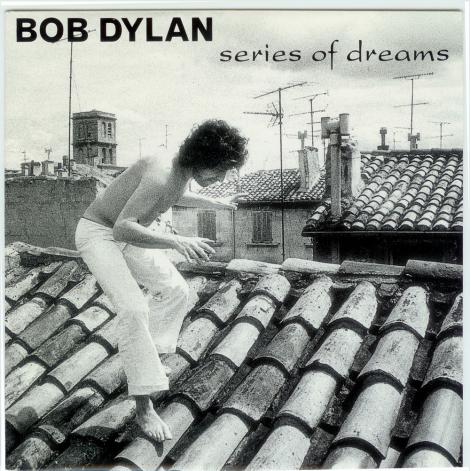
"Series of Dreams" is just that, a series of dreams. This leftover track from the 1989 album "Oh Mercy" was released two years later on the first edition of the Bootleg Series. It's a terrific song, and sounds very much of a piece with the rest of late 1980's pop as it was wending its way into the warmer sounds of the 1990's. It has a kind of glacial majesty that U2 was able to achieve when they didn't ruin it with Bono's homilies to the brotherhood of man and the upper-class alienation of European cities and Wim Wenders films. And it has a good beat. I suspect that opening "Oh Mercy" with it would have not balanced well with the other songs, all of which are more slight in their production. I like this as a standalone. It's too much of a mountain to compete with a bunch of hills.

Series of dreams:
- Nothing comes to the top.
- Everything stops, wounded, at the bottom.
- Nothing specific. Someone wakes up and screams.
- No exit. Time and tempo fly.
- Umbrella is folded. Someone throws it in your path.
- Your cards are no good unless you're playing interstellar poker.
- Numbers were burning.
- He witnesses a crime.
- Running.
- Climbing.

Things he wasn't doing in the series of dreams:
- Nothing too scientific
- Making any great connection
- Falling for intricate schemes
- Nothing that would pass inspection
- Looking for special help
- Going to great extremes (He's already gone the distance)


Santa Fe

Bob's roaming around.
His woman says he can stay.
She's in Santa Fe.

This is another one of those Bob Dylan and the Band Basement Tapes songs that seems to have little lyrical center or serious intent, and that's just fine. Now, that's the song as it appeared in 1967 when it was recorded (and how it sounded when it was released in 1991 in the first of the Bootleg Series albums). The lyrics published on Dylan's website in 1973 differ remarkably. Have a look:

1967 original

Sante Fe,
dear dear dear dear dear Sante Fe
My woman needs every day
She promised to let me stay
She's rollin' up a knot to pray to gods away
She's in Sante Fe
Dear dear dear dear dear Santa Fe.
Now she opens up and lets me home
She's brown but she keeps from roam
She'll open up a happy home
She'll think when will that be warm in Sante Fe.

Sante Fe, dear dear dear dear Sante Fe
She's arms never teach to roam
They're never never far from home
I'll never ever ever roam
To sail away
She's all feel bad
No no no no don't don't don't feel bad
She's the worst thing he's ever had
She's a mad, man that he's so glad
She's over above the hat to bad
She's never disappear so bad
I went away.

Sante Fe, dear dear dear dear dear dear Sante Fe
My own heart city lay
I won't have a nature way
And I'm leavin' every day to run away
From Sante Fe, dear dear dear dear dear Sante Fe.
My woman's left sittin' at home
She's actin' the police unknown
She cried like an evening stone
She leap back under a broom
But she ain't gonna find a room
And the tears send her on own ever day.


1973 rewrite

Santa Fe, dear, dear, dear, dear, dear Santa Fe
My woman needs it ev’ryday
She promised this a-lad she’d stay
She’s rollin’ up a lotta bread to toss away

She’s in Santa Fe, dear, dear, dear, dear, dear Santa Fe
Now she’s opened up an old maid’s home
She’s proud, but she needs to roam
She’s gonna write herself a roadside poem about Santa Fe

Santa Fe, dear, dear, dear, dear, dear Santa Fe
Since I’m never gonna cease to roam
I’m never, ever far from home
But I’ll build a geodesic dome and sail away

Don’t feel bad, no, no, no, no, don’t feel bad
It’s the best food I’ve ever had
Makes me feel so glad
That she’s cooking in a homemade pad
She never caught a cold so bad when I’m away

Santa Fe, dear, dear, dear, dear, dear, dear Santa Fe
My shrimp boat’s in the bay
I won’t have my nature this way
And I’m leanin’ on the wheel each day to drift away from

Santa Fe, dear, dear, dear, dear, dear Santa Fe
My sister looks good at home
She’s lickin’ on an ice cream cone
She’s packin’ her big white comb
What does it weigh?


Sunday, August 16, 2015

Rambling Gambling Willie

Willie won at cards,
Shared his money and his dick.
Then someone killed him.

"Rambling, Gambling Willie" is an affectionate portrait of a coarse male gambler and slut named Will O'Conley who was good to all the women by whom he got his 27 children. O'Conley had one job, as they say, and he did it well, and then one day a guy blamed him for a bad poker hand and shot him in the head, and that was that for ol' Willie. This song appears on the first volume of the bootleg series, released in 1991, though it was recorded in 1962.

The story of Rambling, Gambling Willie:
Chapter 1: In which we learn of Willie's 27 children by a variety of women, none of whom he married.
Chapter 2: He gambled in the White House and in the rail yards. Wives knew to keep their husbands home when he would roll in to town.
Chapter 3: He held a poker session on the Jackson River Queen when he sailed to New Orleans. By the time they finished the game, he owned the boat.
Chapter 4: He held a week-long game in Cripple Creek, Colorado, with the miners, and when he was done, he owned the town.
Chapter 5: Willie didn't just support his progeny, he gave money to the sick and the poor. He didn't spend much of his money on himself.
Chapter 6: Willie was a good bluffer. Once, he beat a guy with a diamond flush and he didn't even have a pair.
Chapter 7: A guy shot Willie in the head and killed him, thinking Willie was to blame for his bad hand. When Willie took his fall, he was holding aces backed with eights.
Chapter 8: Moral: make your money while you can, because once you pull the dead man's hand, you won't be gambling anymore.